


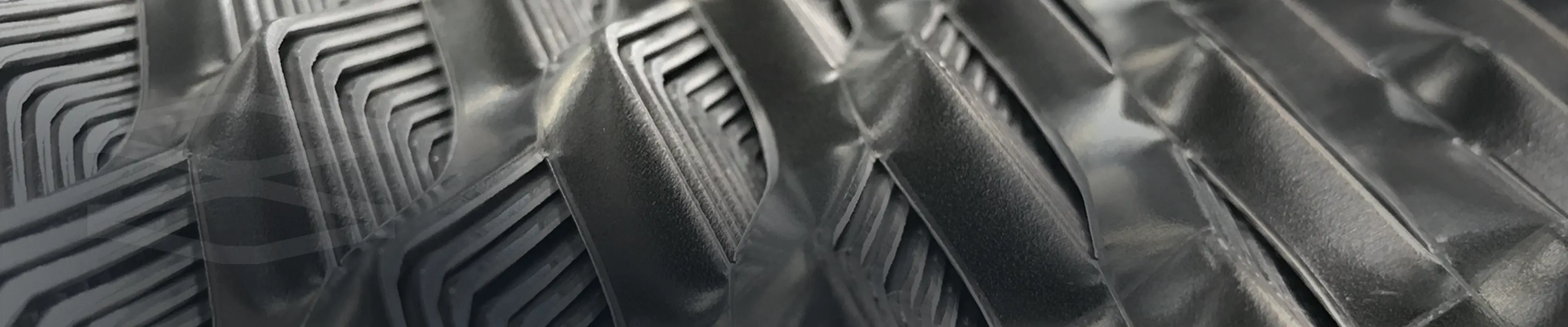

SKA-Variety Expanded Mesh
SKA-V Gradient Expanded Mesh offers architects a distinctive solution for creating depth, rhythm, and visual impact in modern building façades. Through Shang Kai’s exclusive manufacturing technology, the diamond-shaped openings can gradually shift from large to small, small to large, or repeat in customized patterns. This flexible design breaks the rigid image of traditional metal mesh, allowing continuous splicing, bending, and angle changes. It gives architects and designers greater creative freedom while maintaining practical production feasibility.
| Thickness | LW | SW | Opening % | Material | Sheet Size LWMXSWM |
| 1.5 -6.0T | 75 | 15-30 | 15% to 95% | Aluminum Carbon steel, Stainless steel, and Pre-galvanized steel. | Common sizes: 1220x2440 1525x3050 Max Size, Portrait: 1525 x 12000 Max Size, Landscape: 3050 x2200 |
| 101 | 20-50 | ||||
| 115 | 40-55 | ||||
| 135 | 30-65 | ||||
| 152 | 45-86 | ||||
| 175 | 60-70 | ||||
| 200 | 50-90 | ||||
| 250 | 106-116 | ||||
| 300 | 50-152 | ||||
| 400 | 50-160 | ||||
| 500 | 135-160 |
- Unit: mm
- We provide customized expanded metal solutions, including material selection, thickness, mesh opening%, mesh dimensions, sheet size, surface treatment, and other specification requirements.
Key Benefits
1.Visual Control & Ventilation
The mesh can obscure sight lines in sensitive areas while allowing greater openness and airflow where visibility control is less critical.
2.Unique Architectural Appearance
The gradual variation in strand width creates depth, layering, and a distinctive visual identity for building facades and design elements.
3.Optimized Safety & Material Efficiency
Smaller openings can be applied at pedestrian levels for safety and protection, while larger openings in upper areas help reduce material usage and overall project cost.
4.Precise Sunlight & Glare Control
The gradient structure allows more accurate daylight management and glare reduction, making it ideal for sunshade and facade applications.
5.Reduced Light Pollution
In parking structures, greater opacity can be added at vehicle headlight levels to minimize glare and reduce surrounding light pollution.

Q&A | Custom Gradient Expanded Mesh
Q1: What is Custom Gradient Expanded Mesh?
A: SHANG KAI’s custom gradient expanded mesh is manufactured by varying the strand width during the expansion process. While the mesh opening remains consistent from row to row, the strand width gradually becomes thicker or thinner, creating a unique gradient visual effect and functional performance.
Q2: What are the advantages of gradient expanded mesh?
A: Gradient expanded mesh offers both functional and aesthetic benefits for architectural and industrial applications.
Expanded Metal Technical Specifications
- SW: Short Way Dimension of Mesh
Distance between centers in the short way direction of the mesh. - LW: Long Way Dimension of Mesh
Distance between centers in the long way direction of the mesh. - Strand Width:
The width of each strand forming the diamond-shaped opening. - LWM: Length
Direction of the LW diamond. - SWM: Width
Direction of the SW diamond. - Thickness: Material Thickness
- Overall Thickness:
The overall thickness can be approximately 1 to 2.5 times the material thickness. - All thickness, strand width, and weight are subject to a tolerance of +/-5%.
- Standard sheet sizes: 3' x 6', 4' x 8', 5' x 10' and 8' x 4', 10' x 5' (LWM x SWM)
Mesh Style
- Standard / Raised type:
Standard expanded metal, also known as raised expanded metal or 3D mesh type, is produced by slitting and stretching a metal sheet to form diamond-shaped openings.
- Flattened type:
Flattened expanded metal, also known as 2D type, is made by passing standard expanded metal through a rolling process to flatten the raised strands and joints.
Standard / Raised type Flattened type
通用標準尺寸
Meterials
Mild Carbon steel, Stainless steel, Aluminum, Pre-galvanized steel sheet, Electro-galvanized steel sheet, Corten Steel, copper, titanium, nickel, silver, gold, and other ductile metal materials.
Surface Treatment
Hot-dip Galvanizing (Steel), Powder coating, Anodizing treatment, Fluorocarbon coating
