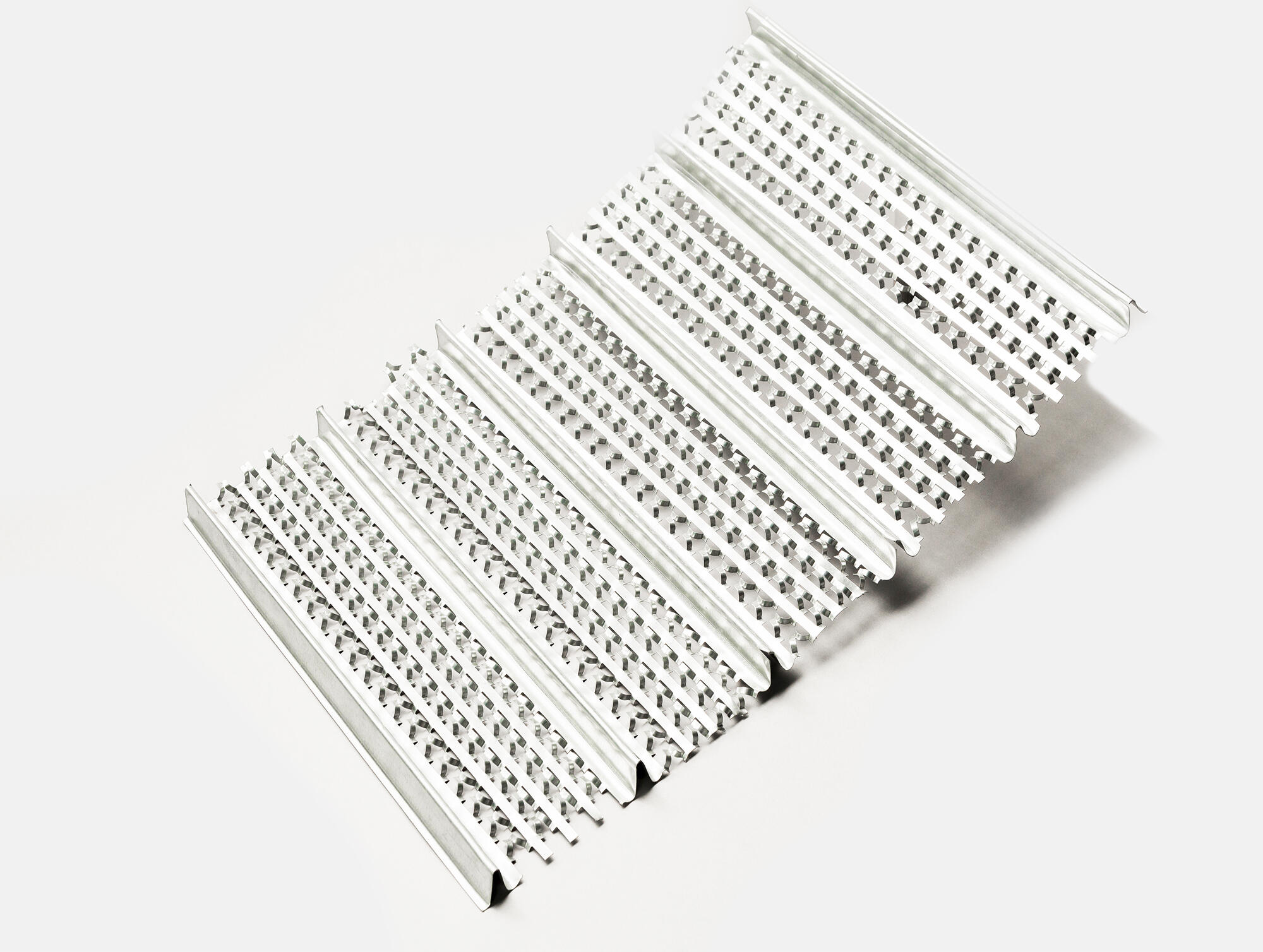

SKRF 24

- Model:SKRF 24
- Thickness:0.75mm
- Weight:6.34 kg/m² (± 10%)
- Lengths:450 x 2000mm (Customized Size available)
- Material:Pre-galvanized steel
| Product Ref. | Generic | Material thickness | Weight kg/m2+/- 10% | Standard sheet size | Material |
| SKRF28 | HR2811 | 0.440 | 3.39 | 2500 / 5000 X 450 | Pre-galvanized steel |
| SKRF26 | HR2611 | 0.575 | 4.86 | 2500 / 5000 X 450 | Pre-galvanized steel |
| SKRF24 | HR2411 | 0.750 | 6.34 | 2500 / 5000 X 450 | Pre-galvanized steel |
- This product complies with
- ASTM C847: Standard specification for metal lath. Ensures the rigidity, strand size, and structural integrity of the ribbed metal lath.
- BSEN 10327-2004: Continuously hot-dip coated strip and sheet of low carbon steels for cold forming
Key Features
- Rib Design: V-shaped / U-shaped ribs for high stiffness & load-bearing capacity
- Mechanical Keying:Open mesh structure enables strong concrete bonding; no scabbling required
- Lightweight: Approx. 3.4–4.2 kg/m² for easy handling & installation
- Material:Pre-galvanized steel with corrosion resistance
- High Efficiency: Ideal replacement for traditional timber or plywood formwork
Applications
- Construction joints
- Walls, beams, columns & soffit slabs
- Floors, stairs, bridge piers & tunnel walls
- Building expansion & repair projects
- Residential & commercial concrete formwork systems
Applicable ASTM Standards
- ASTM International ASTM A653 / A653MStandard Specification for Zinc-Coated (Galvanized) Steel Sheet by the Hot-Dip Process. Ensures corrosion resistance in wet concrete environments.
- ASTM International ASTM F1267Standard Specification for Expanded Steel Mesh, covering material classifications and manufacturing requirements.
- ASTM International ASTM C847Standard Specification for Metal Lath, ensuring rigidity, strand size, and structural integrity.
High Rib Formwork Technical Specifications
1.Installation Method
- Fixed between reinforcement layers
- Installation methods include stapling, nailing, or screwing to steel reinforcement
- Mesh openings allow concrete slurry to pass through for strong construction joints
2.How to Use
Hi-Rib lath is generally installed between outer reinforcement layers. It can be fixed by:
- Stapling
- Nailing
- Screwing to steel reinforcing substrates
The High Rib Formwork design allows concrete slurry to flow through the mesh openings and form strong key joints, making it highly suitable for construction joint applications as well as wall, beam, column, and soffit slab construction.
RELATED PRODUCTS